
Inside the Life and Legacy of Jesse Jackson, the Civil Rights Icon Dead at 84
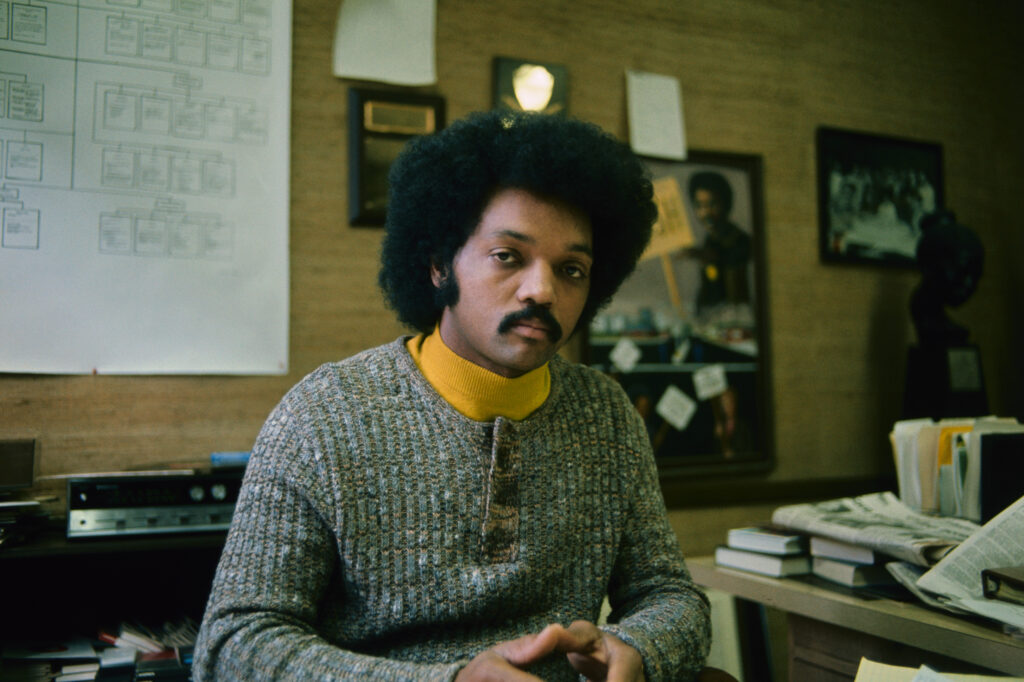
There’s no one other than Rev. Jesse Jackson who truly represents the meaning of the American Dream. From growing up in the Jim Crow south to becoming Dr. Martin Luther King Jr.’s protégé and running for president twice, Rev. Jackson’s life has been nothing short of extraordinary.
As the Black community and the rest of the world continue to mourn the devastating loss of the civil rights icon, we’re diving deep into the life and legacy of Jackson, the man with the plan and
Born in the Jim Crow South

On October 8, 1941, Jesse Jackson was born in Greenville, S.C. to Helen Burns, a hairdresser, and Noah Louis Robinson, cotton grader. His parents separated early, and Jackson was adopted and raised by his stepfather, Charles Henry Jackson, starting when Jackson was only two years old.
Despite his tight-knit household, Jackson couldn’t help but be influenced by the Jim Crow-era he came to age in, according to Morgan State University. Between growing up in poverty, being born out of wedlock and societal pressures as a young Black man, Jackson decided he was going to do something about his future and the future of Black America.
Choosing College

Jackson was always good in school, according to reports. He was even elected his high school class president and participated in multiple sports. That earned him a football scholarship to the University of Illinois, but it didn’t take long for Jackson to leave the predominantly white institution (PWI) to head to an historically black college (HBCU).
Going to NCAT

Jackson got to North Carolina A&T University (NCAT) in 1960, where he was picked to be the starting quarterback for the football team. The South Carolina native exceeded all expectations once he got to the HBCU. The college is also where he met Jacqueline Brown, who he married in 1962.
Jackson also led student protests on campus before graduating from NCAT in 1964 with a degree in sociology, WYFF 4 News reported.
Getting MLK’s Attention

It’s also at NCAT that Jackson started to become active in the bubbling civil rights movement. He met Dr. Martin Luther King Jr. in 1965 during the Selma marches for voting rights. These demonstrations would later become one of the historic markers of the Civil Rights Movement.
Jackson’s tenacity eventually caught King’ Jr.’s attention. He took him under his wing and Jackson was ordained a minister in 1968.
The Assassination of Dr. King

He was notably with Dr. King on April 4, 1968, the day the Civil Rights leader was assassinated at a Memphis motel. In the years following King’s murder, Jackson rose as one of the most prominent leaders of the movement. The national attention often led to conflicts between Jackson and other civil rights leaders.
In 1971, Rev. Ralph Abernathy suspended Rev. Jackson from the Southern Christian Leadership Conference (SCLC)– a organization founded in 1957 and led by MLK. In light of his 60-day suspension over “administrative impropriety,” Jackson broke rank completely, resigned from the organization and founded his own civil rights group.
Founding Operation PUSH

In December 1971, Jackson founded Operation PUSH, which stood for People United to Save Humanity. The “S” was later changed to “Serve” from “Save.” Focused on the economic development of the Black community, PUSH helped young people find consistent jobs, pushed for companies to hire more Black executives and work with Black suppliers. The organization also created several inner-city education programs to serve the youth.
‘Run Jesse Run!’

When Jackson announced his bid as the 1984 Democratic presidential nomination, practically no one took him seriously. It had been 13 years since Shirley Chisholm’s failed presidential bid in 1972, and at this point, many Black folks weren’t hopeful they’ll ever get t see a Black man or woman behind the Oval Office.
Jackson’s 1984 campaign was poorly funded and the odds were stacked against him as a Black man running for office in America. Still, he totaled 384 delegates in primaries and finished third of eight Democratic candidates. Former Vice President Walter Mondale would go on to lose to President Ronald Reagan, who was overwhelming elected for a second term.
The National Rainbow Coalition

One key part of Jackson’s presidential bid was reviving the historic Rainbow Coalition. The original 1969 coalition was founded by Black Panther leader Fred Hampton as a way to unite minority struggles. Jackson revamped the movement in 1984, creating the National Rainbow Coalition.
Running for President… Again
In 1988, Rev. Jackson was back again seeking the Democratic presidential nomination. He’d won the Michigan caucuses early in the year even taking the lead before the nomination race. Jackson did much better this time around, gaining more than 1,200 delegates, according to voting data. In the end, former Mass. Gov. Michael Dukakis became the party’s nominee. He lost to President George H.W. Bush.
Jackson’s Troubled Brother, Noah Robinson Jr.

Noah Robinson Jr.– Jackson’s half-brother– didn’t grow up in the same household as his older brother. Still, Robinson’s tenacity as a businessman and activist allowed him to pave his own path separate from Jackson. In 1989, however, things took a turn after Robinson was arrested of conspiring to kill a business partner and a witness in addition to other drug-related charges, according to the Chicago Sun Times. He was sentenced to life in prison but after 30 years behind bars, Robinson was released.
“Robinson was convicted of brutal crimes, but he is 80 years old and has now been in custody for almost 33 years,” a judge wrote in light of Robinson’s release. “That is a significant period for the purposes of punishment and general deterrence.”
Merging PUSH and the Rainbow Coalition

By 1996, Jackson was looking to refocus his civil rights work. This led him to merge his two most prominent organizations, Operation PUSH and the Rainbow Coalition into one. The Rainbow PUSH Coalition was headquartered in Chicago and grew to hold offices across the country.
‘Both Sides with Jesse Jackson’
From 1992 to 2000, Rev. Jackson was the host of “Both Sides with Jesse Jackson” on CNN. The weekly show was one of the first programs by an African American addressing contemporary social and political issues.
Presidential Medal of Freedom from Bill Clinton

Despite Jackson never holding the highest office, he certainly gained respect as a politician and public speaker. In October 1997, he was appointed by then-President Bill Clinton as “Special Envoy of the President and Secretary of State for the Promotion of Democracy in Africa.” In the role, Jackson traveled to several countries in Africa meeting with leaders like Nelson Mandela and President Frederick J.T. Chiluba of Zambia.
In 2000, Jackson was awarded the Presidential Medal of Freedom by President Clinton. It is the highest civilian honor any person can be given in the nation.
The Jackson Family

On Dec. 31 1962, Jackson married Jacqueline Lavinia Brown. Together, they have five children: Santita, Jesse Jr., Jonathan Luther, Yusef DuBois and Jacqueline Lavinia.
2001 Adultery Scandal

In Jan. 2001, Rev. Jackson finally acknowledged publicly that he fathered a daughter out of his marriage. His child with Karin Stanford, the former head of Rainbow PUSH Coalition’s Washington bureau, was born in 1999. “This is no time for evasions, denials or alibis,” he said. “I fully accept responsibility and I am truly sorry for my actions.”
2008 Election of Barack Obama

Perhaps the biggest champion of former President Barack Obama’s 2008 presidential run was Rev. Jackson. Given the civil rights icon’s previous runs as a Democrat, watching the first Black man become the head of state was quite the emotional experience for Jackson. On election night, he was captured with tears streaming down his face as election results rolled in on that historic night.
‘There’s a “Ferguson” near you’

Days after the death of Mike Brown– an 18-year-old Black boy shot and killed by police in Ferguson, MO.– Jackson penned an op-ed for USA Today titled “There’s a ‘Ferguson’ near you.” In the piece, Jackson wrote:
“It reflects what’s happening in America generally,” he said. “When journalists and politicians speak of a dwindling middle class that’s under economic assault and a poor community that’s getting bigger, they’re talking about Ferguson. Independent of the racial demographics and dynamics of Ferguson, Missouri, there’s a ‘Ferguson’ near you.”
Health Problems

The Baptist minister was diagnosed with Parkinson’s disease in 2015 but announced his diagnosis in 2017, according to reports. In 2021, PUSH revealed Jackson had been hospitalized twice– one time related to COVID-19, CNN reported. Jackson also took a severe fall while at Howard University that same year.
Stepping Down from Rainbow PUSH Coalition

In 2023, Jackson formally stepped down as the head of Rainbow PUSH Coalition. “I want to see us grow and prosper,” he said during his announcement. “We have the ability to build on what we’ve established over the years.”
The organization has continued Jackson’s message. Last year, they joined Black folks’ boycott against Target after they rolled back diversity, equality and inclusion (DEI). Even last month, members of the coalition visited Minneapolis, during the height of President Donald Trump’s ongoing immigration operation.
The Legacy of Jesse Jackson

Late last year, Jackson was hospitalized after being diagnosed with progressive supranuclear palsy. The life-threatening neurological disorder is similar to Parkinson’s disease, which he had been open about in the past. His exact cause of death has not been revealed. Still, his legacy as a powerful orator and history-making activist has earned him respect from political leaders across the spectrum.
“No one else in the Democratic Party was talking about a multiracial, multi-ethnic democracy,” Sen. Bernie Sanders said at an event in Chicago in 2024 celebrating Jackson. “This movement wasn’t just about bringing us together, but about bringing us together around a progressive agenda.”

