
Folks Say Detroit is Making a ‘Comeback’ — But It Never Left
At 139 square miles, Detroit has the heart of a big city and the soul of a familiar friend. There is a 77 percent Black majority, according to Neilsberg — and most are separated by no more than three degrees. To Detroiters, “What up doe?” is not just a greeting but a vibe check.
Home to Belle Isle Park — the island between Detroit and Windsor, Ontario, Canada — the city was once called the “Paris of the Midwest.” Its French roots endure in street names like Lafayette and Cadieux and Albert Kahn’s ornate Art Deco towers. In “The D,” Vernors ginger ale is medicine and late-night coney dogs are the norm.
Detroit’s “cool” revitalization rests on its foundation: Black migration, labor and resilience through systemic neglect.
The $5-a-Day Revolution

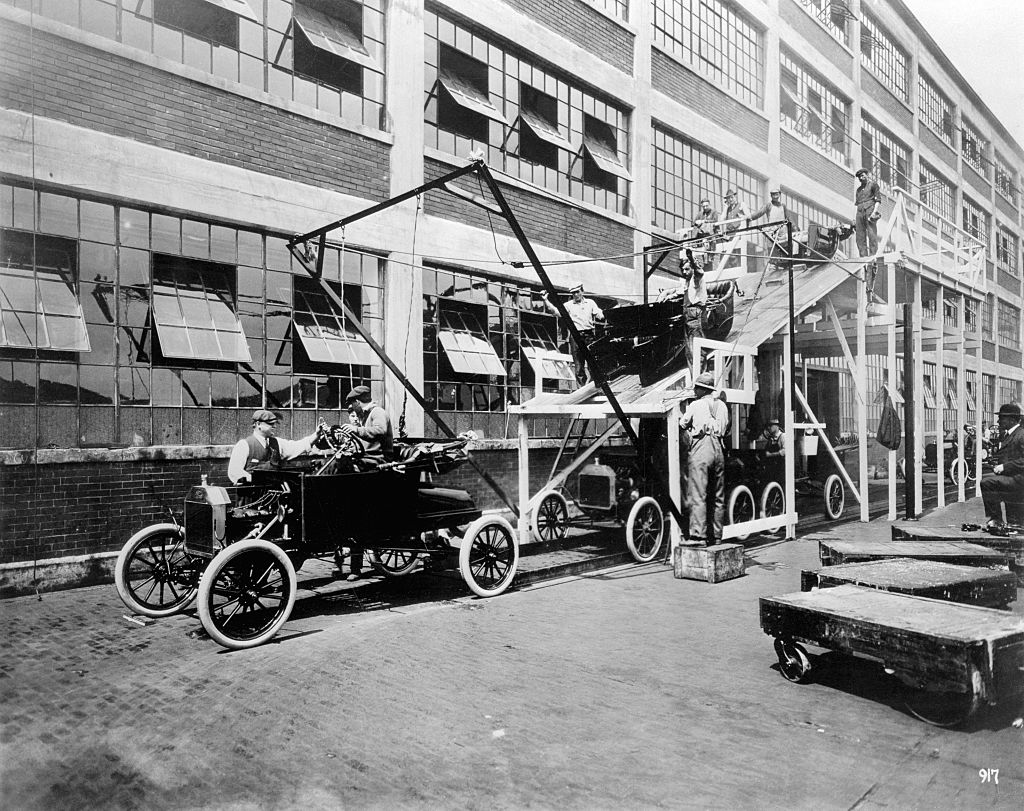
Ford’s Model T, the first mass-produced car, was launched in Detroit in 1908. Ford’s 1913 moving assembly line boosted production, but created grueling, monotonous work. With turnover at 370 percent, Ford nearly doubled wages, offering $5 a day in 1914.
The first auto company to hire Black workers, Ford became the largest employer of African Americans by the end of World War I. Many fled Jim Crow laws in the South, and Detroit’s Black population grew from 6,000 to 41,000 between 1910 and 1920.
Polish, Arab, and other immigrants also worked in Ford’s factories and put down roots in communities across metro Detroit.
Segregation in the Motor City
Social progressiveness did not mean equality. Historians note that Black factory workers were assigned the dirtiest and most hazardous jobs, with sections of the River Rouge complex nicknamed the “house of murder.”
In housing, “restricted covenants and deeds” confined 85 percent of Black Detroiters to overcrowded and subpar conditions of the Black Bottom neighborhood, historian Ken Coleman told WDET. Professionals and middle-class families who sought homes in predominantly white neighborhoods were met with violence.
The Mob at Dr. Sweet’s Home

In 1925, Dr. Ossian Sweet, a 31-year-old Black physician who practiced in Black Bottom, bought a home in an all-white Detroit neighborhood. Hostile residents prompted Sweet to call on relatives and friends, armed for protection, the Detroit Historical Society notes.
A mob surrounded the house, throwing rocks and bottles and yelling threats. Gunfire from inside killed one man, and the mob grew to 5,000. Sweet and 10 others were charged with murder.
Backed by the NAACP and defended by famous trial lawyer, Clarence Darrow, Dr. Sweet’s brother, Henry, was acquitted. The remaining charges were dismissed.
Paradise Valley

By the 1930s, Black Bottom housed more than 100,000 residents, and its neighbor, Paradise Valley, was a cultural hub for Black business, culture and entertainment.
Listed in the Green Book as a haven for travelers, the neighborhood’s jazz clubs, doctors’ offices and Black-owned businesses earned it the nickname “Harlem of Detroit.” It drew headliners like Duke Ellington, Billie Holiday and “Hello, Detroit” singer Sammy Davis Jr.
Race Riot of 1943

During WWII, the NAACP warned officials that “all hell will break loose in Detroit” if they did not act against police violence, racist mob attacks and job discrimination. Less than a year after the warning, 34 people died in the Detroit Race Riot of 1943. Twenty-five of those who lost their lives were Black, and most were killed by police.
Mid-Century Boom to Bust

At its peak in the 1950s, Detroit was home to nearly two million people. The auto industry powered middle-class dreams, and Motown Records began turning talent into hitmakers from a modest two-story house in Detroit’s New Center Area. However, a 1958 recession pulverized Detroit’s auto industry, leaving more than 25,000 residents — nearly 20 percent of them Black — jobless for more than a year.
Urban Renewal

As automakers fled the city for cheaper labor or automated technology, Detroit lost more than 130,000 auto jobs between 1948 and 1967. “Urban renewal” obliterated neighborhoods, bulldozing them for freeways. Black Bottom and Paradise Valley were demolished for I-375 by the early 1960s, displacing thousands.
Detroit’s Dream Speech

Two months before the March on Washington, Detroit marched on Woodward Avenue. On June 23, 1963, 125,000 people joined the Walk to Freedom and Martin Luther King Jr. delivered a version of “I Have a Dream” at Cobo Hall.
It was a call to action that didn’t just confront Southern segregation, but called out Northern hypocrisy of housing, schools, policing and employment, demonstrating that Detroit’s civil rights struggles were deeply tied to neglect.
The ‘1967 Detroit Riot’ (’12th Street Riot’)

What started as a police raid on a west-side “blind pig”(an illegal after-hours party) became five days of rebellion. A loosely trained National Guard of 9,000, armed with military-grade weapons, was deployed to hunt for “snipers” in Black neighborhoods. In the end, 43 people were killed (33 of them Black residents), 1,200 were injured and 7,200 were arrested.
A commission later connected the uprising to disinvestment, segregation and harassment, but nothing changed and many hard-hit neighborhoods never recovered.
The ‘Murder Capital’ Era

By the end of the Great Migration in 1970, 660,000 African Americans called Detroit home, according to Ford From the Road. Detroit elected its first Black mayor, Coleman Young, in 1973, as white flight accelerated and the city earned the label “Murder Capital.”
In the 1980s, Detroit’s infamous Young Boys Incorporated (YBI) led organized drug crime, violence surged, police corruption rose and Devil’s Night arson became an annual spectacle. Many Black families left Detroit, seeking greater safety and better schools in suburbs like Southfield and Oak Park.
The ‘Bad Boys’ Years

A reflection of the city’s gritty reputation, the Detroit Pistons went hard with physicality and talent, claiming back-to-back national championships in 1989 and 1990, led by Isiah Thomas. The “Bad Boys” identity became a mark of defiant pride for the entire region.
Kilpatrick’s Hope and Scandal

When Kwame Kilpatrick was elected in 2002 at just 31, Detroit had recently opened three commercial casinos and bet big on the “Hip-Hop Mayor.” By the time the “Malice at the Palace” brawl erupted in 2004, rumors were swirling about a party at the Manoogian Mansion and the mysterious shooting of exotic dancer Tamara Greene.
Explicit text messages with his chief of staff, use of a city-leased red Lincoln Navigator, and a web of bribery accusations led Wayne County Prosecutor Kym Worthy to indict Kilpatrick in 2008, forcing his resignation.
Autos Saved, City Sacrificed

After the Great Recession hit, the federal government rescued General Motors and Chrysler in 2008 because the corporations were deemed “too important to fail,” but the City of Detroit had no safety net. Emergency management replaced elected leadership in a city that was 80 percent Black.
$18 Billion Collapse

Detroit was pushed into bankruptcy, putting the unthinkable on the line: pensions and retiree benefits. According to CBS News, in 2013, the City owed benefits to about 21,000 retirees, totaling $3.5 billion in pensions and $5.7 billion in health coverage.
Climbing Out

Mike Duggan’s 2014 election marked a turning point, and Detroit exited bankruptcy by year’s end. Under his leadership, downtown revitalization accelerated: the Riverwalk expanded, Little Caesars Arena opened, blight removal increased and the city landed national events like the 2024 NFL Draft.
But as corporate investment returned, Gallup found that quality education and safety remained residents’ primary concerns. Black Detroiters also continued to cite pressing need for affordable housing, jobs and neighborhood services.
A Rebranded City

Since 2024, Michigan Central Station has reopened, construction began on the Hudson’s tower and luxury retailers line the Q Line corridor. Downtown hosts the annual tree lighting, the Detroit Grand Prix and the Ford Fireworks over the Detroit River. Much of this revival reflects developer Dan Gilbert’s vision in Downtown and midtown.
As gentrification trades blight for joggers, dog walkers and mural art, the poverty rate has risen to nearly 35 percent, and senior homeowners struggle to pay taxes and utilities.
What’s Next
In January, Detroit elected its first Black female mayor, Mary Sheffield, whose vision brings policy and people together. As new chapters are written at City Hall, the Spirit of Detroit proudly wears jerseys for four professional sports teams, the bronze Joe Louis fist suspended in mid-air, and the city preps for epic summer days and nights.
Detroit’s identity is reflected in its motto: “Speramus Meliora; Resurget Cineribus”—we hope for better days; it shall rise from the ashes.

